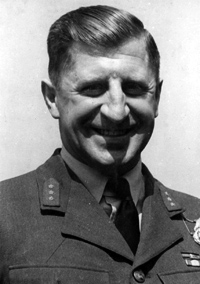
Władysław Nowak
Władysław Jan Nowak was born on 11 June 1908 at the village of Chocznia, at the time in the Austrian-occupied part of Poland, subsequently in the Wadowice county of the Cracow Province (now Małopolska province). Józef and Franciszka née Nowak were his parents. He graduated from the elementary school at Wadowice and started his secondary school there, at the ‘Marcin Wadowita’ National Secondary School (Państwowe Gimnazjum im. Marcina Wadowity). He completed the final two years of secondary school at the ‘King Jan Sobieski’ National Secondary School (Państwowe Gimnazjum im. Króla Jana Sobieskiego) at Złoczów near Tarnopol, where he passed his maturity exams in 1930.
He joined the army on 12 September 1930. After a unitary course with the 17th Infantry Regiment in Rzeszów, he joined the Infantry College (Szkoła Podchorążych Piechoty) at Różan. He was promoted Lance Corporal Officer Cadet (starszy szeregowiec podchorąży) on 3 May 1931, and Corporal Officer Cadet (kapral podchorąży) on 15 June 1931. The following day he transferred to the Artillery College (Szkoła Podchorążych Artylerii) in Toruń. He was promoted Corporal Officer Cadet (ogniomistrz podchorąży) on 19 March 1932, and Artillery Sergeant a year later. After graduating from Artillery College, he was commissioned at the rank of 2nd Lieutenant (podporucznik) on 15 July 1933. He was posted to the 9th Heavy Artillery Regiment (9 Pułk Artylerii Ciężkiej) at Siedlce.
Still as an officer cadet, he had volunteered to join the air force and then successfully passed air force medical tests, so upon his commission he was posted for flying training. From 3 September 1933 he underwent a course at the Air Force Officers’ Training Centre (Centrum Wyszkolenia Oficerów Lotnictwa) at Dęblin. Upon completion of the course, he was posted to the 2nd Air Regiment (2 Pułk Lotniczy) in Cracow on 16 August 1934. He became a pilot of the Breguet XIX-equipped 22nd Line Flight (22 Eskadra Liniowa).
On 15 April 1935, he was posted to the Air Gunnery and Bombing School (Lotnicza Szkoła Strzelania i Bombardowania) at Grudziądz, for an advanced flying training course, which he completed on 28 June 1935. Following a leave, he returned to the 2nd Air Regiment on 7 July 1935, with a posting to the 123rd Fighter Flight (123 Eskadra Myśliwska), which at the time was converting from the PWS-A (licence-built Czech Avia BH-33) to the Polish PZL P.7 aeroplanes.
He was officially transferred to the aeronautics (air force) branch on 31 August 1935.
On 20 January 1936, he was slightly injured in an accident of PZL P.7 (serial no. 6.107), which overturned during a forced landing caused by lack of fuel.
He was transferred to the PZL P.7-equipped 122nd Fighter Flight on 31 March 1936, which soon started re-equipment with the PZL P.11c. In September and October 1936 he participated in a glider flying course at the Military Glider Centre (Wojskowy Ośrodek Szybowcowy) at Ustjanowa.
He was promoted Lieutenant on 19 March 1937.
On 9 August, he suffered an accident in PZL P.11c (serial no. 8.35). During air-to-air firing at the Pustynia Błędowska firing range 2nd Lt Antoni Ostowicz in P.11c (serial no. 8.148) collided with his aeroplane due to carelessness. Both pilots escaped unhurt, and the airframes were slightly damaged.
He led a section of three pilots (with 2nd Lt Antoni Ostowicz and L/Cpl Jan Kremski) during the national Central Fighter Competition (Centralne Zawody Myśliwskie), held in Toruń between 4 and 10 October 1937. The section, representing the III/2 Fighter Squadron (III/2 Dywizjon Myśliwski) of the 2nd Air Regiment, won the first prize. Since it was the third victory of the Cracow squadron in this competition, the Colonel Jasiński Fighter Cup, founded by the Minister of Military Affairs, was won outright by the unit.
Nowak was re-posted as an advanced flying instructor to the Flying Training School (Szkoła Pilotażu) at Grudziądz on 10 March 1938. On 3 April 1939 the whole school moved to the Ułęż airfield near Dęblin, and he continued to be an instructor there.
He married Miss Maria Danuta Ziarkiewicz at Stanisławów (now Ivano-Frankivsk, Ukraine) on 11 April 1939.
Following the German invasion of Poland Nowak was appointed the commander of a fighter section of Ułęż instructors, with the task of defending the Dęblin area. Between 1 and 3 September he has flown several patrols on PZL P.7 aeroplanes, but did not engage in combat. A few days later (probably on 10 September) he flew a P.7 to Lwów (now Lviv, Ukraine) area and was forced to leave the aeroplane there due to lack of fuel. Together with other pilots he was evacuated by road via Tarnopol (now Tarnopil, Ukraine) towards the Romanian border. They crossed the border on 17 September around 11 p.m. at Kuty (now in Ukraine). In Romania, via Rădăuţi and Focşani, he made it to the town of Tulcea, and together with other officers he was sent to the detention facility at Călimăneşti. At the beginning of November 1939 he illegally travelled to Bucharest where he received false civilian documents at the Polish embassy. Then he made it to the Black Sea port of Balcic (now Balchik, Bulgaria), to be evacuated by sea to France. He eventually left Romania on the night of 18/19 December, aboard ‘Patris’, which carried more than 1,000 Poles.
After a few days the Poles disembarked in Beirut, where they spent Christmas and the first days of 1940. Nowak was in the group of Poles leaving for France aboard ‘Explorateur Grandidier’ on 16 January. They arrived in Marseille on 22 January. He spent the following week at Camp de Carpiagne near Marseille, and then he was at the assembly station at Septfonds near Toulouse from 29 January. He was re-posted to the assembly station at Le Bourget near Paris on 11 March 1940.
He received a posting to the Polish Air Force Training Centre (Centrum Wyszkolenia Lotnictwa; Depot d’Instruction de l’Aviation Polonaise) at Lyon-Bron on 23 May 1940, and to the Centre’s Training Fighter Flight at Mions airfield near Lyon on 30 May. Upon the collapse of France, together with other aviators, he began evacuation on 18 June, and embarked on ‘Arandora Star’ at Saint-Jean-de-Luz on 21 June, arriving in Liverpool on 27 June. He was at the Polish Air Force Depot in Blackpool from 2 July, formally re-joining the Polish Air Force in Britain (formed according to the Polish-British Agreement of August 1940), and receiving the service number of P-0721.
On 4 September 1940 he was posted to No. 306 ‘City of Toruń’ Squadron, then being formed at Ternhill in central England, equipped with Hawker Hurricanes. After a short conversion training on British equipment, using a two-seat Miles Master, Nowak flew a Hurricane fighter for the first time on 22 September. No. 306 Squadron pilots engaged the enemy for the first time on 13 November 1940, and the following day Nowak flew his first operational sortie with No. 306. During the next several months he flew patrols without encountering the enemy.
He had a slight landing accident in Hurricane I V6948 UZ-R on 28 February 1941.
In April 1941 he moved with the entire No. 306 Squadron to Northolt, where the 1st Polish Wing was formed. It participated in defensive operations, initially, but commenced intensive operations over France and Belgium with the advent of June 1941.
Since the Luftwaffe had switched from daytime to night raids, nominal daytime units started to be switched to night operations in defence of Britain. It was during these, on the night of 10/11 May 1941, that Władysław Nowak became the first Polish fighter pilot credited with a German aeroplane destroyed at night: a Heinkel 111 over London.
He became No. 306 Squadron’s ‘A’ Flight Commander on 13 May.
On 19 May 1941, he took off leading No. 306 Squadron for a patrol over Maidstone, but was forced to return to base due to a technical failure of Hurricane II Z3154 UZ-H. The Squadron was attacked by Messerschmitts just as it was regrouping behind the new leader. The Germans shot down three Hurricanes – one pilot was killed, and two other baled out wounded. Nowak made a forced landing in his aeroplane at Ewhurst, but was not seriously injured.
No. 306 Squadron pilots started conversion training on Supermarine Spitfire IIs at the end of June 1941. Nowak flew this type for the first time on 30 June.
During ‘Circus 30’ operation on 3 July 1941, still on Hurricane IIs, his aeroplane (Z3502 UZ-J) was damaged by enemy fire. He flew his first Spitfire combat sortie on 17 July 1941. Almost a week later he was shot down in air combat, himself credited with two Messerschmitt 109s damaged. Burned, he baled out over the English Channel from Spitfire IIB P8247 UZ-F. He was rescued by an English boat and taken to Dover, where he was hospitalised. A few days later he was moved to Ely hospital near Cambridge, and several months later, to the RAF hospital at Torquay in Cornwall, for convalescence.
He returned to Northolt at the beginning of October 1941, where his No. 306 Squadron had been based, which, however, at that time had moved to another airfield for a rest from operations. For the next few months he remained at RAF Northolt with a non-effective posting as a convalescent.
In February 1942, he was posted to No. 308 ‘City of Cracow’ Squadron as an Operations Room controller. His duties included informing airborne fighter pilots by radio about the situation in the air and guiding them onto German aeroplanes. At the end of March 1942, he was re-posted to a similar post at No. 317 ‘City of Wilno’ Squadron that had just moved to Northolt.
On 5 June 1942, he took over a prestigious post of ADC to the President of Poland in Exile, Mr Władysław Raczkiewicz, and remained in this role until mid-August 1943.
From 15 August 1943, he served at staff posts at the Polish Air Force Inspectorate in London. On 2 April 1944 he became the Senior Polish Liaison Officer at the HQ No. 9 Group RAF. From 25 September 1944 he was the Senior Polish Liaison Officer at the HQ Air Defence of Great Britain (ADGB).
In January 1945, he completed a tactics-intelligence course at the Polish Air Force Staff College at Weston-super-Mare. On 1 March 1945 he was promoted to the Polish rank of Major.
He was re-posted to No. 5 Polish Resettlement Unit at Framlingham on 28 February 1947, to prepare for demobilisation and civilian life. He was demobilised from the Polish Air Force on 1 March 1949 as a Polish Major and RAF Flight Lieutenant. His decorations included the Cross of Valour (Krzyż Walecznych) & 2 bars, the Air Medal (Medal Lotniczy) & 2 bars, the Operational Pilot’s Wings (Polowy Znak Pilota; no. 725) and the Honorary Insignia for Wounds and Injuries (Odznaka Honorowa za Rany i Kontuzje).
After the war ended, he learned about the death of his wife, killed by the Germans on 24 April 1942 in Stanisławów for her activity with the Home Army resistance movement. He married Henryka Michna, serving with the Women’s Auxiliary Air Force (Polish Branch) on 28 June 1947. Their first daughter, Krystyna, was born on 18 March 1948, and their second daughter, Hanna, on 28 August 1951. The Nowaks settled in Lincoln. In the following years Władysław Nowak worked at various food production facilities. The family moved to the town of Worksop on 1 November 1954, where the couple then ran a café and a grocery store for the next 26 years.
Władysław Nowak died in Sheffield on 28 February 1982, aged 74. He was buried at the Retford Road Cemetery at Worksop.
His wartime memoirs were published in 2012 under the title ‘Squadron Leader Władysław Jan Nowak. Biography. Diary’.
Date |
Aeroplane |
Unit |
Confirmed destroyed |
Probably destroyed |
Damaged |
| 10/11.05.1941 | Hurricane II Z2969 UZ-F | 306 Squadron | He 111 | ||
| 23.07.1941 | Spitfire IIB P8247 UZ-F | 306 Squadron | Bf 109 | ||
| 23.07.1941 | Spitfire IIB P8247 UZ-F | 306 Squadron | Bf 109 | ||
Total |
2 |
0 |
0 |
Wojtek Matusiak