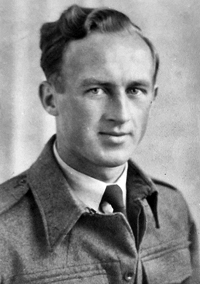
Edmund Miterski
Edmund Miterski was born on 4 August 1922 in Ostrołęka, in Białystok province (now Podlaskie province). His parents were Edmund and Antonina, née Dulkiewicz. He had a sister, Danuta. His father was a career NCO in the Polish Army, holding the cavalry rank of Sergeant (wachmistrz). From 1918 he served in the 5th Uhlan Regiment (5 Pułk Ułanów). He was a veteran of the Polish-Soviet War, a recipient of the Virtuti Militari and the Cross of Valour (Krzyż Walecznych).
Edmund junior grew up and was educated in Białystok, where he attended the 1st ‘Marshal Józef Piłsudski’ State Secondary School (I Państwowe Gimnazjum im. Marszałka Józefa Piłsudskiego).
In September 1939, after the Third Reich invaded Poland, he was evacuated as a Scout from Białystok to Wołkowysk (now Vawkavysk, Belarus), and then to Wilno (now Vilnius, Lithuania). There, around 12 September 1939, he volunteered for the army, joining the Wilno Scout Volunteer Battalion (Wileński Harcerski Batalion Ochotniczy) under the command of Lt Józef Grzesiak. The battalion was disbanded shortly after the Soviet invasion of Poland. On 17 September 1939 Miterski decided, together with other military units, to cross into Lithuania; on 22 September 1939 he crossed the border at Zawiasy. He was interned in the camp at Birsztany (now Birštonas, Lithuania), but escaped on 27 September and made his own way back to Poland, to the family home in Białystok, which was then under Soviet occupation.
On 13 April 1940, during the so-called second wave of deportations of Polish citizens, he and his family were taken from their home and deported by rail to Kazakhstan. After a journey lasting 17 days he reached the Pavlodar region, where he, his mother and his sister were assigned to work on a state farm. At first they were quartered in farm buildings that had until recently served as a cowshed and a pigsty, and only later in a normal residential building. He worked, among other things, drying manure for fuel, haymaking and as a blacksmith’s assistant. In 1941, after completing a tractor drivers’ course, he took part in the spring sowing. While living in the Soviet Union he contracted typhus and twice suffered from malaria.
After the terms of the Sikorski-Mayski Agreement, signed in London on 30 July 1941, were announced, he was released to join the Polish Army being formed under the orders of Lt Gen. Władysław Anders. He received his call-up on 15 October 1941, with orders to report to Tatishchevo near Saratov. He did not manage to get there, however, because the Polish military authorities first directed him to Tashkent, Samarkand and Bukhara in Uzbekistan, and finally to Farap in Turkmenistan, to a Polish camp for civilians. From there he was sent to work by the Aral Sea. Because of the difficult living conditions, he escaped and returned to his family in Kazakhstan.
His second attempt to join the Polish Army in the USSR was successful and, on 15 January 1942, Miterski was enlisted in the army. As a volunteer for the air force, he was sent to the Air Force and Navy Grouping at Koltubanka. When it was decided that no Polish Air Force units would be formed in the Soviet Union, he set off with this centre on the long journey to Great Britain. At the end of January 1942 he travelled to Kermine in Uzbekistan and then to Krasnovodsk on the Caspian Sea. From there he went by ship to Pahlevi in Iran. On 17 April 1942, from another Iranian port, Bandar Shahpur, he sailed aboard the troopship HMT ‘City of Canterbury’ for Bombay, India. He then travelled aboard the New Zealand troopship HMT ‘Awatea’ to Cape Town in South Africa, and after transferring there to the Norwegian SS ‘Bergensfjord’, sailed for Great Britain on 16 May 1942. After a voyage across the Atlantic, he reached Glasgow on 6 June 1942.
On 16 July 1942 he was temporarily assigned to the army, to the 3rd Battalion of the 1st Independent Parachute Brigade (1 Samodzielna Brygada Spadochronowa) in Scotland. On 28 August 1942 he was transferred to the Polish Air Force, with the service number 704131, and posted to the Polish Air Force Depot at Blackpool. He volunteered for aircrew training and on 13 September 1942 was assigned to the Polish Air Crew Training Centre at Hucknall. On 19 December 1942 he was transferred to the Polish Initial Training Wing at Brighton. After successfully passing the theory course, on 19 May 1943 he returned to Hucknall to begin flying training at No. 25 (Polish) Elementary Flying Training School. He trained on Tiger Moth aircraft, but on 7 July 1943 he was suspended from flying and sent back to the Polish Air Force Depot at Blackpool.
Like many would-be pilots, he was re-mustered as a trainee bomb aimer and, on 28 July 1943, was sent to the Aircrew Despatch Centre at Heaton Park in preparation for practical training in Canada. In mid-August 1943 he left Liverpool aboard the troopship HMT ‘Aquitania’ for New York, and then travelled by train to the assembly base at No. 31 Personnel Depot in Moncton, Canada, where he arrived on 24 August 1943. On 4 September 1943 he was posted to No. 1 Bombing and Gunnery School at Jarvis, where he trained on Anson and Bolingbroke aircraft. On 3 January 1944 he was transferred to No. 4 Air Observer School in London, Ontario. On 5 February 1944 he returned to No. 31 Personnel Depot in Moncton and was sent back to Great Britain.
On 15 March 1944 he was posted to No. 7 Personnel Reception Centre at Harrogate, a transit unit for airmen returning from training outside Great Britain. Between 9 May and 20 June 1944 he was assigned to No. 3 (Observers) Advanced Flying Unit at Halfpenny Green, where he flew practice bombing sorties. On 20 June 1944 he was posted to the Polish Air Force Depot at Blackpool, where he again spent several weeks waiting for the next stages of training. Finally, on 18 August 1944, he went to the Polish Aircrew Training Wing at Morecambe for a short theory course, and on 29 August 1944 to No. 18 Operational Training Unit at Finningley. On 2 December 1944, together with all the Polish personnel at that centre, he was transferred to No. 10 Operational Training Unit at Abington, where he completed crew training on Wellingtons. On 29 December 1944 his crew was posted for conversion training on four-engined aircraft to No. 71 Base at Lindholme, where a flight engineer joined them.
On 27 March 1945 Miterski was posted to No. 300 ‘Mazovia’ Bomber Squadron at Faldingworth. His crew consisted of Sgt Julian Gryglewicz (pilot), Sgt Kazimierz Dziuś (navigator), Sgt Stefan Margula (flight engineer), Sgt Józef Roman (radio operator), Sgt Stanisław Jeronim (air gunner) and Sgt Wincenty Sterynowicz (air gunner). Before the end of the war, Miterski took part in two operational bombing sorties. These were daylight raids on Heligoland on 18 April 1945 and Berchtesgaden on 25 April 1945. A third sortie, on 22 April 1945, against Bremen, was called off after less than an hour and a half, and Miterski’s crew returned to base after jettisoning its bombs.
From 29 April to 7 May 1945 Miterski took part in six flights dropping humanitarian aid to the civilian population of the Netherlands as part of Operation ‘Manna’. In May and June 1945 he also participated in the evacuation of liberated Allied prisoners of war to Great Britain, Operation ‘Exodus’, and in flights carrying medicines to the continent.
On 10 May 1945, aboard Lancaster I BH-R (PB730), he was flying a transport sortie with 24 former prisoners of war being carried from Melbroek in Belgium to RAF Wing in England. During landing the aircraft’s undercarriage unexpectedly collapsed and the four-engined bomber crashed. None of the crew or passengers was injured.
Miterski served with No. 300 ‘Masovia’ Bomber Squadron until it was disbanded at the beginning of January 1947. After the Polish Air Force in Exile was disbanded, he joined the Polish Resettlement Corps. On 9 January 1947 he was assigned to the demobilisation unit No. 8 Polish Resettlement Unit at Skipton-on-Swale. Under contract he served with the supply unit No. 246 Maintenance Unit at Bicester, from 3 April 1947 to 8 March 1948, and with No. 9 Polish Resettlement Unit at Melton Mowbray, from 8 March to 30 April 1948, and No. 3 Polish Resettlement Unit at Dunholme Lodge, from 30 April 1948. He decided to emigrate to Australia and on 2 July 1948 was transferred to Tilbury near London to await departure. He set out on the long voyage aboard the ‘Strathnaver’ and reached Sydney on 10 August 1948, in a group of 220 Polish airmen.
Edmund Miterski was formally demobilised on 11 August 1948 in the Polish rank of Lance Sergeant (plutonowy) and the British rank of Warrant Officer. He was awarded the Air Medal (Medal Lotniczy) and two bars, as well as British campaign medals.
During WWII his parents, Edmund and Antonina, and his sister Danuta also served in the exiled Polish Armed Forces; all three served in the 2nd Polish Corps (2 Korpus Polski), including in the Italian campaign.
In Australia he initially lived in a migrant camp at Bathurst. At first he worked as a manual labourer on the railways in New South Wales. Around 1958 he worked as a student diesel engineer in Wau, New Guinea. On 1 April 1958 he enlisted in the RAF. After arriving in the United Kingdom, he served at, among other places, RAF Sandwich (28 June – 12 July 1958) and RAF Bempton (2 August – 16 August 1958). He was discharged at his own request on 1 November 1958 and rejoined his family in Australia.
At the turn of 1959–1960, he began working at the telecommunications company AWA Technology Services in Ashfield, where he remained for the rest of his career. He retired as a transport manager.
On 20 October 1949 he received Australian citizenship. That same year he became one of the founders of the Polish Air Force Association, which operated as a section of the RAAF Association. He was an active committee member and the treasurer of the PAFA. In 1972 he travelled to the United Kingdom and, for the first time, to Poland, where he visited Warsaw.
In 1952 he married Irena, née Schachter. They had two children: a daughter, Barbara, born in 1953, and a son, Edmund, born in 1964.
Warrant Officer Edmund Miterski died on 18 October 1997 at the age of 75. He was buried at Rookwood Cemetery, Sydney.
Wojciech Zmyślony