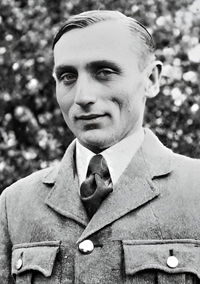
Józef Lewandowski
Józef Lewandowski was born on 24 October 1909, in the village of Gubiny in Pomerania, then in Prussia, in what would subsequently become the Grudziądz County of the Pomeranian Province (now in the Grudziądz County of the Kuyavian-Pomeranian Province). His parents, Leon and Franciszka née Matuszewska, had nine children, born over nearly a quarter of a century: Bronisław (1892), Helena (1894), Anna (1897), Leokadia (1901), Franciszek (1903), Marianna (1906), Władysław (1908), Józef (1909), and Marta (1916).
Józef graduated from a seven-year primary school at Grudziądz in 1924. Then, between 1924 and 1927, he attended a three-year Merchant and Crafts Supplementary School (Kupiecka i Rzemieślnicza Szkoła Dokształcająca) at Mickiewicza Street, where he learned the fitter trade. While still a school pupil, he worked at the Autowarsztaty Bernard Mroczyński company at Grudziądz. Following graduation, he was employed by the same company as a fitter apprentice, repairing motor vehicle engines. Then, between 1928 and 1930, he worked at the PPG (Polish Rubber Industry, Polski Przemysł Gumowy) company at Grudziądz, where he was responsible for the inspection and repair of machinery. The company was known throughout Poland for its footwear (primarily Wellington boots and snow boots), rubberised fabrics, bicycle tyres and tubes, raincoats, and rubber hoses.
Upon turning 21, Lewandowski began his national service with the Polish Army, serving with the 4th Air Regiment (4 Pułk Lotniczy) in Toruń from 24 October 1930 to 10 October 1932, rising to the position of assistant mechanic. He completed an NCO training school there (between 10 May 1931 and 8 August 1931) and was discharged into the reserves with the rank of corporal.
Following his return to civilian life, he briefly worked for a private transport company as a driver (between 1 November 1932 and 1 April 1933). He then rejoined the armed forces as a civilian contract employee. He lived outside the barracks, worked eight hours a day, and wore civilian clothing (a special armband pass). He initially underwent specialised training (as part of the Polish Air Force Technical Training Centre), after which he was employed as an assistant foreman, and then as a foreman, at the Grudziądz airfield, which housed the Polish Air Force Gunnery and Bombing School (Centrum Wyszkolenia Technicznego Lotnictwa), among other establishments. From 1935, he worked in a similar position at the maintenance park of the 4th Air Regiment in Toruń, where he dealt with minor aircraft overhauls. Also in 1935, he was promoted to Lance Sergeant (reserve), and in August 1937, he passed his master fitter civilian exams.
Shortly before the German invasion of Poland, he was attached to LWS (Lublin Aircraft Factory, Lubelska Wytwórnia Samolotów) in Lublin. During mobilisation in August 1939, he was not drafted into the army, working in a reserved trade with the defence industry. His exact actions during the 1939 Polish Campaign are not known. After the Soviet invasion of Poland, he was evacuated to Romania, where he was then held in an internment camp at Calafat for a while. He escaped and then travelled, with help of the Polish military authorities, via Yugoslavia to Greece, from where he went to France by sea, arriving in early January 1940 (probably on the s/s ‘Warszawa’ from Piraeus to Marseille, between 29 December 1939 and 2 January 1940). He joined the exiled Polish Forces at Le Bourget Assembly Station in Paris. He was sent to the Amiot aircraft factory in Cherbourg with a group of pre-war Polish aircraft industry staff, working there for several months at the airframe assembly.
Following the announcement of armistice talks between France and the Third Reich on 16 June 1940, he left Cherbourg to evacuate to Britain. He arrived there by sea on 27 June 1940, most probably with the transport of Polish Air Force staff aboard ‘Arandora Star’, which sailed from Saint-Jean-de-Luz to Liverpool. Initially, he stayed at a temporary camp for Polish Air Force staff in Gloucester, and he was transferred to RAF Hereford on 5 September 1940, and then to the Polish Air Force Depot at Blackpool on 12 October 1940. He re-joined the exiled Polish Air Force and was allocated service number 792400.
He was posted to No. 46 Maintenance Unit at RAF Lossiemouth, Scotland on 15 October 1940. This unit was responsible for storage and modifications of the Wellington twin-engined bombers, which were then delivered to operational units (including all Polish bomber squadrons: Nos. 300, 301, 304, and 305). On 8 January 1941, he was re-mustered to Flight Mechanic, Engine (FME).
He was re-posted to the ‘B’ Flight of No. 317 ‘City of Wilno’ Squadron on 16 April 1941. There he worked on single-engined fighters, initially Hurricane Is, and from July 1941, Hurricane IIs. The squadron re-equipped with Spitfire Vs in October 1941, and retained the variant until September 1943. During Lewandowski’s service with No. 317 Squadron, it was for a long time at the front line of aerial war, initially as part of the 2nd Polish Wing at RAF Exeter (between July 1941 and March 1942), and then of the 1st Polish Wing at RAF Northolt (between April and September 1942). In September 1942, No. 317 Squadron returned to the 2nd Fighter Wing, which had become a rear formation by then, with squadrons based at various airfields in northern England. Lewandowski serviced the engines of all the aircraft types listed above, and on 26 August 1941, he was re-mustered to Fitter II, Engine (FIIE).
He completed a Chief Mechanic Course at the Technical Training School at RAF Halton between 9 April and 22 May 1943, following which he returned to No. 317 Squadron. Between 9 and 13 June he was attached to RAF Cranfield, where No. 317 Squadron Spitfires were converted to LF.V standard by No. 3501 Servicing Unit. Between 21 November and 4 December 1943 he was attached to Rolls-Royce.
Late 1943 and early 1944 saw numerous organisation changes that affected Lewandowski and all of the ground staff of No. 317 Squadron, which were part of the preparations of the RAF and the exiled Polish AF for the invasion, and in particular for the need to operate from forward airfields and to change these frequently. No. 3110 Servicing Echelon was formed from the ground crew of No. 317 Squadron and it was re-assigned to Spitfire V-equipped No. 306 Squadron on 21 September 1943. On 28 October 1943, Lewandowski and the rest of No. 3110 Echelon staff were re-posted to No. 133 Airfield Headquarters at Heston (as a number-less unit still attached to No. 306 Squadron). In March 1944 it was renamed as No. 6306 Servicing Echelon. On 28 April 1944, Lewandowski was re-posted to No. 6315 Servicing Echelon that supported No. 315 Squadron, but two weeks later, on 12 May 1944, he returned to No. 6306 Echelon, eventually appointed the head of the repair and overhaul section. He continued to serve with No. 6306 Echelon, working on No. 306 Squadron aircraft (Mustang IIIs starting from April 1944), until the disbandment of the exiled Polish Air Force in early January 1947. He was appointed to command No. 6306 Servicing Echelon on 10 January 1946. No. 306 Squadron was part of No. 133 Wing (the 2nd Polish Wing) with two other squadrons throughout this time, and its operations included supporting the invasion of Normandy, intercepting the V1 flying bombs, and flying long-range missions over the Third Reich. It was based at various airfields in southern and eastern England (the longest period was spent at Andrews Field) and Wales. From August 1945, Coltishall was its permanent base.
During his service with No. 6306 Echelon, he underwent several specialised training courses. Between 21 January and 4 February 1945, he was attached to D. Napier & Son for a Sabre engine maintenance course. Between 14 and 28 July 1945, he completed a maintenance course on Merlin engines licence-built by Packard in the USA (USAAF designation V-1650) at No. 21 School of Technical Training at Burtonwood. He completed a practical oxyacetylene welding course at BOC (British Oxygen Company) Ltd between 1 and 19 October 1945.
Lewandowski decided to remain in exile and became a member of the Polish Resettlement Corps on 17 January 1947. While preparing for civilian life, he was posted to No. 3 Polish Resettlement Unit at Dunholme Lodge and then No. 5 Polish Resettlement Unit at Framlingham. He was hospitalized for a while at the RAF hospital at Cosford. Between 9 July 1947 and 3 September 1948, he was at RAF Upper Heyford. He decided to emigrate to Canada and upon arrival there, on 13 October 1948, was officially demobilised with the RAF rank of Sergeant (he had temporarily held the rank of Acting Flight Sergeant for a while). He was awarded the Polish Bronze Cross of Merit (Brązowy Krzyż Zasługi) and Air Medal (Medal Lotniczy), as well as British campaign medals (the Defence Medal and the War Medal 1939–1945), and the Good Conduct Badge. In the 1990s, he posthumously received the Cross of the Combat Deed of the Polish Armed Forces in the West (Krzyż Czynu Bojowego Polskich Sił Zbrojnych na Zachodzie).
Lewandowski left Britain aboard RMS ‘Empress of Canada’ on 6 October 1948, arriving in Quebec City a week later. He settled permanently in Edmonton, Alberta. In partnership with another man he opened a Ford dealership called Alta Motors at Mundare, Alberta in 1951, selling cars, lorries, and tractors. The business failed two years later, and Lewandowski found employment as a mechanic at Waterloo Mercury Lincoln Motors company, where he eventually became a foreman.
He married Adela Jekel, née Tepper, in Edmonton on 14 May 1949, a Polish widow who had also immigrated to Canada in 1948. The couple had one child, a son, Dennis, born in 1959. He changed his name to Joseph Henry Linden on 30 November 1964.
Flight Sergeant Joseph Linden (Józef Lewandowski) died in Edmonton on 30 October 1966, aged 57. He was buried at the Holy Cross Cemetery in Edmonton.
Wojciech Zmyślony
(translation by Wojtek Matusiak)