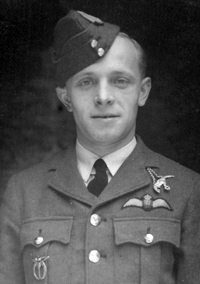
Jozef Kaňa
Jozef Kaňa was born on 26 September 1914, at Krupina (at the time in Austro-Hungarian Empire, subsequently in Czechoslovakia, now in Slovakia), to a shoemaker Ľudovít Kaňa and Katarína, née Makovníková, both of Slovak ethnic origin. He had two younger sisters and an older half-brother. After attending a primary school at Krupina, the artistically and musically gifted Jozef began studying at the Pedagogical Institute (Československý štátny koedukačný učiteľský ústav ) in Banská Bystrica in 1930. However, he did not complete the studies and spent the next two years at a vocational school in Banská Bystrica, training as a fitter. His carefree youth was cut short by his father's premature death in 1933. After completing his apprenticeship, Jozef worked as a mechanic and driver.
Kaňa was conscripted in April 1936 for two years of military service starting in October 1936. However, due to medical issues, he did not begin his service until a year later. While on medical leave, he joined the Aero Club of Central Slovakia (Stredoslovenský aeroklub) flying school in Zvolen. This enabled him to receive state funding for his flying training as part of the national programme called ‘1,000 new pilots’, aimed at training new pilots as part of preliminary military education. Kaňa successfully completed this elementary flying training between May and September 1937 and received the his private pilot's certificate. After a reassessment of his medical condition he was found fit for service with the Czechoslovak Air Force.
Aircraftman (vojak) Kaňa joined Flight 38 (Letka 38) at Vajnory on 1 October 1937, and completed his initial military training there. In November 1937, he was posted to the NCO school (pilots' branch) of Air Regiment 3 (Letecký pluk 3) at Piešťany, from which he successfully graduated in January 1938. He then completed training as a two-seater aircraft pilot at the regimental Pilot School II of Air Regiment 3 between February and August 1938. During this period, he was promoted to the rank of lance corporal (slobodnik).
After completing his pilot training, he was transferred to the reconnaissance Flight 15 (Letka 15) at Žilina on 15 August 1938. This flight was part of the 4th Squadron (IV peruť) of Air Regiment 3. He continued his service with Flight 15 until the dissolution of Czechoslovakia. There, he primarily flew single-engine, two-seat observation and light bomber aircraft, such as the Letov Š-328 Šmolík.
Following the dissolution of Czechoslovakia and the formation of the independent Slovak Republic on 14 March 1939, he automatically became a member of the Slovak Air Force, remaining with the same unit. However, Nazi German troops occupied the Žilina airfield on 15 March 1939, just hours after the Slovak Republic was established. This was followed by the complete looting of Flight 15's assets, including 27 aircraft, fuel, armament, ammunition, parachutes, and other equipment. This resulted in the unit‘s subsequent disbandment.
LCpl Kaňa was transferred to the reconnaissance Flight 64 (Letka 64) at Piešťany on 1 April 1939. Soon afterwards, a group of NCOs formed within the flight, who disagreed with the conditions in the new ‘independent’ state and its undemocratic orientation inspired by Berlin and Rome. LCpl Kaňa was one of those who declared his political views in public, for which he was briefly imprisoned by his superiors in the regimental prison. Following these events, a group of eight NCOs formed around Sgt Ľudovít Ivanič, the chief mechanic of Flight 64, decided to join the Czechoslovak resistance abroad. Slovak pilots departed from the Piešťany air base at noon on 7 June 1939. LCpl Kaňa flew Š-328 no. 155 of the flight, with LCpl Karol Valach as the other crew member. Other aeroplanes flew with the following crews: Cpl (pilot) Ján Lazar and Sgt František Knotek (Letov Š-328 no. 344); Cpl (pilot) Imrich Gablech and Cpl Jozef Rehak (Letov Š-328 no. 342), and Cpl (pilot) Jozef Hrala and Sgt Ľudovít Ivanič (Aero Ab.101 no. 15) The trio of Slovak Air Force Letov Š-328s (still bearing original Czechoslovak markings) finally landed at the Dęblin air base in Poland, while the Aero Ab.101 with Hrala and Ivanič landed at the Kraków-Rakowice airfield. For this ‘desertion’, LCpl Kaňa and his colleagues were sentenced in absentia to life imprisonment by a military court in Bratislava.
From 1 July 1939, until the outbreak of World War II, Jozef Kaňa was employed as a civilian instructor pilot at No. 1 Air Force Training Centre (Centrum Wyszkolenia Lotnictwa nr 1) at the Dęblin base. His name was often entered in documents in a Polish form, as ‘Józef Kania’. He was a pilot of the Observer Training Flight (Eskadra Ćwiczebna Obserwatorów), under Capt. Jan Hryniewicz.
Following the Luftwaffe air raid on 2 September 1939, Kaňa was among the pilots who ferried aeroplanes to Góra Puławska and other reserve airfields in eastern Poland. In the following days, he and other pilots of the Observer Training Flight continued to retreat east until 17 September 1939, when the individual Czechoslovak pilots concentrated at Smyga. That day Poland was invaded by the Soviet Union, and the group split into smaller ones, to have a better chance of reaching Romania. Two days later, three Czechoslovak pilots, Jozef Kaňa, Oldřich Kestler and Tomáš Motyčka, reached Tarnopol (now Tarnopil in Ukraine), already occupied by the Red Army. They were arrested and imprisoned by the Soviets there. Jozef Kaňa was imprisoned with Oldřich Kestler until 13 October 1939. The third member of the group, Tomáš Motyčka, was released from the Soviet prison the next day and probably deported to the Soviet Union at his own request. Kaňa and Kestler then made it to the town of Kuty on the Romanian border. On 16 October 1939, they crossed the Czeremosz river under machine gun fire of Soviet border guards and were detained on the other side. Kaňa was subsequently convicted by a civil court in Cernăuți for illegally crossing the border and imprisoned again. He was later transferred to the internment camp in Buzău. A few days later, he and Kestler escaped to Bucharest. After completing the formalities at the Polish consulate, Kaňa and Kestler left Bucharest on 9 November 1939, for the Black Sea port of Constanța. Kaňa boarded the Romanian ship MS ‘Transilvania’ and sailed to Beirut. There, he boarded the French ship SS ‘Champollion’, which arrived Marseille on 21 November 1939.
Jozef Kaňa traveled by train with a group of Polish airmen from Marseille to Lyon, where he spent several days in the barracks of the Fort de Bron. Soon in the nearby air base of Lyon-Bron the Polish Air Force Training Centre (Centrum Wyszkolenia Lotnictwa) was established. Kaňa joined the Polish Air Force in France on 15 December 1939, at the rank of sergeant (sierżant). At the turn of January 1940, Czechoslovak airmen who had been serving with the Polish Air Force since the summer of 1939 became of interest to the Czechoslovak military authorities in France. In particular, the Czechoslovak military attaché in Paris, Col. Václav Kalina, requested that NCOs (Josef Balejka, Josef František, Jozef Kaňa, Matěj Pavlovič, Ladislav Uher, and others) join the exiled Czechoslovak Air Force. However, all of the above-mentioned refused and remained with their Polish friends.
Sergeant Kaňa was posted to join the air crew designated for the 1st Observer Squadron (I Dywizjon Obserwacyjny). He began his refresher training in March 1940 on the following French aircraft: Caudron C.635M Simoun, Caudron C.445M Goéland, and Potez 63-11 A.3.
While in Lyon, Sgt Kaňa met Božena Kocman, a young woman from Czechoslovakia who was living and working in the city. After a few weeks of romance, the couple married in Lyon in April 1940.
Two days after the sudden German strike in the Western Europe, on 12 May 1940, a group of 20 pilots under Lt Mieczyslaw Wolański were sent from Lyon to Châteaudun. The group became part of No. 301 Maintenance Unit (Entrepôt de l'Armée de l'Air 301; EAA 301) under Col. Joseph Chatelain. The pilots of Wolański's group primarily ferried aircraft from this depot to operational units.
Shortly after arriving in Châteaudun, on 17 May 1940, Sgt Kaňa took off for a familiarization flight in the Morane-Saulnier MS.406-C1 no. 49 (N-360). After 15 minutes of uneventful flight, he forgot to lower the undercarriage, and belly-landed, damaging the aircraft, and receiving minor injuries. Because of the crash, Kaňa was posted to the Fighter Training Centre (Centre d'Instruction à la Chasse; CIC) at Cazaux for further training. Two days later, on 19 May 1940, Sgt Oldřich Kestler was tasked with ferrying Potez 630 no. 34 from Dijon to Chartres. Sgt Kaňa, who wanted to reach the CIC in Cazaux more quickly, was his passenger. Kestler lost his orientation during the flight, ran out of fuel, and had to make an emergency landing on one engine. He managed to do so without damaging the aircraft near the village of Friardel in the Calvados department.
Kaňa finally reached the CIC at Cazaux by other means. He was promoted to the rank of staff sergeant (starszy sierżant) during his training there. Available sources do not say when he completed his fighter training there. It is unclear if he rejoined the pilot group of Lt Mieczyslaw Wolański, which operated within EAA 301.
After the fall of France, on 22 June 1940, Jozef Kaňa made it from France via North Africa to Great Britain. After arriving in the United Kingdom, he was stationed in Glasgow for a short time while awaiting his next assignment alongside other Polish airmen. In July 1940, he was at the Polish Air Force Depot at Blackpool, where he joined the Polish Air Force. Later he was assigned the personal service number 794087 and given the RAF rank of Flight Sergeant. He waited for his next posting until 21 August 1940, when he joined No. 303 (Polish) ‘Tadeusz Kościuszko’ Squadron at Northolt. He became a pilot of the squadron's ‘B’ Flight. Shortly after Kaňa's arrival, No. 303 Squadron became an operational unit.
F/Sgt Kaňa was one of the pilots of No. 303 Squadron, who required training on Hawker Hurricanes. On 2 September 1940, he completed his first solo flight in Hawker Hurricane I RF-S (V7289). Following three training sorties, F/Sgt Kaňa flew his first operation on 11 September 1940, a patrol in the Northolt airfield area with S/Ldr Ronald G. Kellett and F/Lt John A. Kent. Three days later, he took off in Hawker Hurricane I RF-T (L1696) for a training sortie involving air combat with Sgt Marian Bełc and R/T practice. After landing, he was taxiing the Hurricane when the landing gear suddenly collapsed, causing minor damage to the aircraft. On 16 September 1940, Kaňa was transferred to No. 6 Operational Training Unit at Sutton Bridge for further training. He returned to No. 303 Squadron on 6 October 1940. F/Sgt Kaňa flew with the squadron for the last time on 9 January 1941, in Hawker Hurricane I RF-O (R4081). This was shortly before the squadron re-equipped with Supermarine Spitfire Is. In total he flew 10 operational sorties with No. 303 Squadron.
F/Sgt Kaňa was transferred from Northolt to RAF Leconfield on 22 January 1941, where he became a member of the forming Polish No. 315 (Polish) ‘Dęblin’ Squadron, with which he flew a total of twelve training sorties. The squadron moved to RAF Speke on 13 March 1941, and was declared operational shortly thereafter. On 5 April 1941, F/Sgt Kaňa was suspended in operational flying for medical reasons and attached to RAF Speke Station Sick Quarters. He remained a formal member of No. 315 Squadron until 22 April 1941.
He was then posted to RAF Kemble, where he served with the Headquarters Service Ferry Pools until 15 June 1941, when he was posted to the Polish Air Force Depot at Blackpool. He waited until 16 July 1941, for his next posting. He then joined No. 2 Central Flying School at RAF Church Lawford, where he attended an instructor pilot‘s course, which he completed on 31 July 1941. Subsequently, as an instructor, F/Sgt Kaňa was posted to No. 16 (Polish) Service Flying Training School (16 (P)SFTS) at RAF Newton, where he served until 5 January 1942. Ten days after arriving at the new unit, on 8 October 1941, F/Sgt Kaňa flew a training sortie with pupil pilot LAC Henryk Juchniewicz in Fairey Battle I (T) (R7383). Juchniewicz practised take-offs and landings. During one of the landings, the pupil pilot failed to lower the undercarriage and belly-landed. Instructor F/Sgt Kaňa was reprimended about carelessness. During his service in No. 16 (P)SFTS, he was promoted to the Polish rank of Warrant Officer (chorąży).
In early January 1942, W/O Jozef Kaňa was posted to No. 1 Anti-Aircraft Co-operation Unit at RAF Weston Zoyland. Its main activity was towing targets for anti-aircraft artillery. At Weston Zoyland, W/O Kaňa served with the ‘P’ Flight of this unit, primarily flying Hawker Henleys, Westland Lysanders, Hawker Hurricanes and Miles Masters, until the unit ceased to exist on 31 October 1942. On 2 April 1942, en route to the School of Anti-Aircraft Defence at Watchet, W/O Kaňa made an emergency belly landing at Blue Anchor village due to engine failure in Hawker Henley I (L3361). Following a reorganisation, the ‘P’ Flight of No. 1 AACU became No. 1601 (Anti-Aircraft Co-operation) Flight on 1 November 1942 and remained at RAF Weston Zoyland. W/O Kaňa served with No. 1601 (AAC) Flight for the next year, flying Hawker Henleys, Miles Martinets and Fairey Barracudas. He had another accident in this unit on 3 September 1943. Hawker Henley I (L3266) with dual controls flown by an instructed pilot, F/Lt Leon Kułakowski, struck a lorry on the perimeter track while taxiing. The instructor pilot, W/O Kaňa, was to blame for the accident, as he had not instructed the pupil pilot in the front seat to keep a lookout. Another incident involving this aircraft, Hawker Henley I (L3266), occurred on 26 October 1943, when W/O Kaňa was providing training to Polish pilot, Sgt Roman Białecki. The aircraft swung on landing, and the pilots failed to correct this, resulting in the undercarriage collapsing. The investigating board acknowledged that W/O Kaňa was not responsible for the crash.
As part of a further reorganisation of No. 70 (Army Co-operation Training) Group RAF, No. 587 Squadron RAF was formed at RAF Weston Zoyland on 1 December 1943. It absorbed all three of the original AAC flights from Weston Zoyland (Nos. 1600, 1601 and 1625). W/O Jozef Kaňa became a pilot of the squadron's ‘C’ Flight. The flight provided training for target operators and conversion training for pilots, who were to serve with squadrons of No. 70 Group RAF. W/O Jozef Kaňa‘s service with No. 587 Squadron was interrupted briefly in January 1944, when he was transferred to No. 631 Squadron at RAF Towyn for several weeks. The last accident of his wartime flying career occurred there on 20 February 1944. W/O Kaňa was flying Hawker Henley I (L3325) with a LAC Gibson as target operator. Their role was to tow targets for the RAF Regiment at its No. 4 Anti-Aircraft Practice Camp at RAF Towyn. After flying over Cardigan Bay for two hours, the engine stalled. W/O Kaňa was forced to make an emergency ditching approximately 400 yards off the Towyn coast. LAC Gibson saved his pilot, and neither of them was injured. They were picked up from the sea by crews of DUKW amphibious vehicles of No. 1 Amphibious Training Wing of the Royal Army Service Corps at Towyn, training at the time. Although the pilot was not at fault for the accident, both he and the target operator were disciplined for not wearing ‘Mae West’ life vests while flying over the sea.
Kaňa then returned to No. 587 Squadron, stationed at the time at RAF Weston Zoyland and RAF Culmhead. He remained there until the beginning of 1946. During this time, he flew Hawker Henleys, de Havilland Tiger Moths, Airspeed Oxfords, Miles Martinets, Supermarine Spitfire Vs and XVIs, Hawker Hurricanes and Vultee Vengeances.
W/O Kaňa‘s service with No. 587 Squadron came to an end on 1 March 1946, when he was transferred to No. 309 (Polish) ‘Land of Czerwień’ Squadron at RAF Coltishall as a supernumerary pilot. Just two weeks later, he received a posting to the Polish Air Force Depot at Dunholme Lodge.
For his wartime service Jozef Kaňa was awarded the following Polish and British decorations: Cross of Valour (Krzyż Walecznych), Air Medal (Medal Lotniczy), Operational Pilot’s Wings (Polowy Znak Pilota; No. 477), 1939–1945 Star with the Battle of Britain Clasp, Air Crew Europe Star, Defence Medal, War Medal 1939–1945 and Good Conduct Badge. However, his war service was never officially recognised by the Czechoslovak or later Slovak authorities. He was honouralby discharged with the Polish and RAF rank of Warrant Officer (chorąży).
Immediately after the end of the Second World War, Jozef Kaňa made contact with his family in France and Czechoslovakia. Despite having a son together, his wartime marriage with Božena Kocman failed to withstand several years of separation, and they divorced.
After the war, Jozef Kaňa decided not to return to Czechoslovakia. In early 1947, he joined the Polish Resettlement Corps (PRC) and was stationed at No. 3 Polish Resettlement Unit at Dunholme Lodge. However, he left the PRC just a month later. After leaving the PRC, he moved and changed jobs several times. In 1949, he married Madge N. Payne, an Englishwoman and a former Women's Auxiliary Air Force member whom he had met during the war. He obtained the British citizenship on 21 November 1950 and left for Africa with his wife in the mid-1950s. They settled in Kenya, where he first worked as an assistant manager and later as a farm owner near the town of Naivasha. After divorcing again, Jozef Kaňa worked for the Food and Agriculture Organization of the United Nations (FAO) in Somalia in the second half of the 1960s.
The further fate of Jozef Kaňa is unknown. It is likely that he remained in Africa until the end of his life.
Milan Herčut