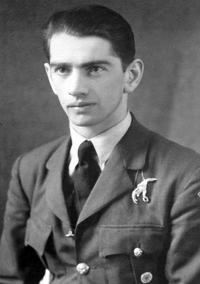
Jerzy Schmidt
Jerzy Schmidt was born on 2 November 1916, at Pułtusk. He passed his maturity exam at the ‘Adam Mickiewicz’ State Upper Secondary School for Boys (Państwowe Gimnazjum Męskie im. Adama Mickiewicza) in Wilno (now Vilnius, Lithuania) in 1937, and joined the military service the same year. He chose to become a career air force officer. He completed a glider flying course at the Military Glider Centre (Wojskowy Ośrodek Szybowcowy) at Ustianowa in the Bieszczady Mountains in the summer of 1937, and on 21 September 1937, he was posted for a divisional reserve officer cadet course at the 5th ‘Legion’ Infantry Regiment (5 Pułk Piechoty Legionów) of the 1st ‘Legion’ Infantry Division (1 Dywizja Piechoty Legionów) in Wilno. Every officer candidate was required to complete such a course. On 2 January 1938, he joined the Polish Air Force College (Air Force Officer Cadet School (Szkoła Podchorążych Lotnictwa) at Dęblin. He trained as a pilot and he completed fighter pilot training at the Flying Training School (Szkoła Pilotażu) at Ułęż in the summer of 1939, flying PZL P.7 aircraft.
Upon the outbreak of the war, he was selected to join a group of 10 officer cadets who were ordered to collect P.7 fighters from No. 1 Polish Air Force Training Centre (Centrum Wyszkolenia Lotnictwa nr 1). Following several airfield changes, on 10 September 1939, Schmidt joined the PZL.37 Łoś-equipped 15th Bomber Squadron (XV Dywizjon Bombowy) under Capt. Stanisław Cwynar at Wielick. He flew patrols as part of the fighter cover of the squadron's airfield, and also reconnaissance sorties. The 15th Squadron moved to an airfield at the village of Bohorodyczyn near Obertyn (now Bogorodichin near Obertin, Ukraine) on 16 September, and then, upon hearing of the Soviet invasion of Poland, the unit was ordered to evacuate to Romania on 18 September. During this move, Schmidt stayed behind at an airfield, ordered to ferry an LWS-3 Mewa aeroplane to Dżurów (now Dzhuriv, Ukraine), on the Romanian border. He took off on 19 September before midday. During the flight, he was repeatedly under fire from the Soviets. The aircraft had its aileron cables, main spar, and the cockpit transparency shot through. Since Red Army units were already at Dżurów, Schmidt decided to fly on to Romania at his own risk. He landed at Storojineţ (now Storozhynets, Ukraine). After the aeroplane was repaired, he flew to Cernăuţi (now Chernivtsi, Ukraine), where the Polish consulate issued him with a passport, and thence he flew to Iaşi. His aeroplane was requisitioned there, and he went to Bucharest by train. He obtained money from the Polish authorities for his onward journey. He went to Belgrade, Yugoslavia, by train, and then via Italy to France. He crossed the border at Modane on 10 October 1939. He was posted to the Polish aviators’ assembly station in Paris.
He became seriously ill and was hospitalized in Paris in January 1940. He had not recovered completely by the time France collapsed. He was evacuated by sea to Britain, arriving there on 26 June 1940 (the date suggests he travelled aboard ‘Arandora Star’ from Saint-Jean-de-Luz to Liverpool). His treatment continued in a hospital in Liverpool.
Following convalescence, he completed a refresher flying training course, after which he was posted to No. 58 Operational Training Unit (58 OTU) at Grangemouth on 1 June 1941. He completed his fighter training there on 13 July 1941, and was posted to No. 303 Squadron. At that time, the unit was based at RAF Speke near Liverpool for a period of rest. It was temporarily equipped with Hurricane Is, soon replaced by Spitfire Is, and its primary duties included convoy protection and operational training of inexperienced pilots. Schmidt then arrived at the front line of aerial operations once the unit moved to Northolt near London and re-equipped with Spitfire VBs in October 1941. From then on, he regularly flew bomber escort, fighter sweep, and ground attack operations over occupied Europe. During one such mission, ‘Circus 138’ on 26 April 1942, Spitfire VB RF-C (AB899) he was flying was damaged by Messerschmitts. Nevertheless, Schmidt managed to return safely to his home airfield.
Schmidt left with the entire No. 303 Squadron for a rest at Kirton-in-Lindsey in the north in mid-June 1942, but already on 6 July 1942 he was re-posted to No. 453 Squadron RAAF that was re-forming in Britain at the time, which operated from RAF Drem. On 29 September 1942, he transferred to No. 65 Squadron RAF (which replaced No. 453 at that airfield). In both units, he flew Spitfire Vs, already well-known to him. He returned to No. 303 Squadron, still at Kirton-in-Lindsey, on 15 October 1942. His Spitfire VB RF-J (AB786) was damaged during a sortie over the Netherlands on 13 November 1942. This time, it was accidentally hit by his own wingman, Sgt. Aleksander Rokitnicki, with whom, flying in close formation, they attacked barges on a canal north of the town of Goes.
His transfer to non-Polish squadrons may have been related to a disciplinary offence Schmidt committed in the first half of 1942. He used for his personal purposes approximately a gallon (about 4.5 litres) of petrol earmarked exclusively for military vehicles, and this was discovered during an internal check. His trial took place in November 1942, and he was formally convicted in 1943 by the 3rd Field Court and sentenced to a severe reprimand and a three-month loss of seniority.
Schmidt left No. 303 Squadron for rest from operations on 10 May 1943, posted again to No. 58 OTU in Grangemouth, this time as an instructor at the Polish Fighter School attached to that OTU. He was re-posted to a similar position at No. 61 OTU at Rednal on 4 October 1943, due to a move of the Polish Fighter School. On 23 November 1943, he was posted to No. 302 Squadron, flying Spitfire IXs from Northolt.
He was re-posted to No. 84 Group Support Unit (84 GSU) at Thruxton on 5 May 1944, where he probably converted onto the Mustang III. He moved to No. 315 Squadron, flying these American fighters, on 10 June 1944. It was with that unit that he achieved his greatest successes as a pilot. During a ground-attack bombing mission on 24 June 1944, No. 315 Sqn together with No. 306 engaged about 40 Luftwaffe fighters over Tilliers. Schmidt was credited with one Focke-Wulf 190 destroyed. He scored another Fw 190 on 18 August 1944, during the famous combat of No. 315 Squadron against the Germans at Beauvais (operation ‘Rodeo 385’). He also participated in anti-V1 operations over southern England in the summer of 1944. He claimed two ‘flying bombs’ destroyed individually (on 20 August 1944) and two shared (3 August 1944).
Schmidt was re-posted to No. 306 Squadron on 21 September 1944, but he returned to No. 315 less than a month later, on 20 October, taking command of the ‘B’ Flight. That same month, he moved with the unit to RAF Peterhead in Scotland, flying operations to Norway from there. On 6 December 1944, he took off as part of a cover for 18 Beaufighters attacking German shipping off the Norwegian coast (operation ‘Roadstead’). On the way back, his Mustang III PK-U (HB833) suffered engine failure. The pilot decided to ditch, which ended in the aeroplane sinking rapidly, with the pilot still trapped in the cockpit. This took place at 3:15 PM at the approximate coordinates of 59°47’N 00°04’E, about 70 km southeast of the Shetland coast and approximately halfway between Norway and RAF Peterhead. According to another version, the engine failed after fuel had been used up completely in one of the tanks and failed to restart after switching to another, causing the aeroplane to hit the water. The pilot’s body or the wreckage was never found.
Flight Lieutenant Jerzy Schmidt flew a total of 120 combat and 32 operational sorties from Britain. He was awarded the Cross of Valour (Krzyż Walecznych) and two bars, the Polish Air Medal (Medal Lotniczy) and two bars, and the Operational Pilot’s Wings (Polowy Znak Pilota; No. 1033).
He is remembered with a symbolic grave at the Powązki Cemetery in Warsaw.
Date |
Aeroplane |
Unit |
Confirmed destroyed |
Probably destroyed |
Damaged |
| 24.06.1944 | Mustang III, PK-E (FX995) | 315 Squadron | Fw 190 | ||
| 18.08.1944 | Mustang III, PK-Z (FB363) | 315 Squadron | Fw 190 | ||
Total |
2 |
0 |
0 |
Date |
Aeroplane |
Unit |
Destroyed |
| 03.08.1944 | Mustang III, PK-Z (FZ160) | 315 Squadron | 1/2 x V1 |
| 03.08.1944 | Mustang III, PK-U (FB192) | 315 Squadron | 1/2 x V1 |
| 20.08.1944 | Mustang III, PK-M (HB849) | 315 Squadron | V1 |
| 20.08.1944 | Mustang III, PK-M (HB849) | 315 Squadron | V1 |
Total |
3 |
Wojciech Zmyślony
(translation by Wojtek Matusiak)